
August 2026 Admissions News
August 2026 Preview –
What’s Coming This Month
📅 Mark Your Calendars – Upcoming 2026 Dates
🔬 Rising Researchers – Fall and Winter Camps Have Launched!
🎓 Rising Seniors – What’s The Deal on Demonstrated Interest?
🎓 ApplicationIQ –There’s Still Time to Join Semester 2 of Application IQ!
⚕️ Med School Applicants – Secondary Essay Triage: How to Prioritize When They All Arrive at Once
📷 In the News – Moon Prep Featured Articles
📊 University Updates – What You Need to Know
🎙 White Coat Club Podcast – Dual Feature – Shadowing and Research Experience
Mark Your Calendar!
✅ August 1: The Common Application Opens for the Class of 2027
✅ August 7: August SAT – Registration Deadline
✅ August 14: September ACT – Registration Deadline
✅ August 14: New York Times Editorial Contests [Writing]
✅ August 17: Tech Flex Leaders
✅ August 22: MCAT Test Date for applicants still testing late in the cycle; applicants should understand how a late score may impact their school review.
✅ August 23: The New York Historical Student Historian Internship Program
✅ August 28: September SAT – Registration Deadline
✅ August 31: Columbia Scholastic Press Association Gold Circle Awards [Journalism]
✅ September 4: August SAT Score Release
✅ September 15: Breakthrough Junior Challenge [STEM]
✅ September 15: Scholastic Journalism Week Poster Contest [Journalism]

Fall and Winter Camps Have Launched!
Fall and Winter Research Camps have launched giving students the opportunity to build hands-on research skills, explore areas of interest, and gain meaningful experience outside of the traditional classroom.
These programs are a great option for students looking to strengthen their research background, develop a deeper understanding of the scientific process, and prepare for future academic and pre-health opportunities.
Interested students are encouraged to explore the available camps and register early, as space is limited.
Register now to save $200 with the Early Bird Discount!
Fall Camp: Exploring Topics in Neuroscience + Research Methodologies, Led by Shvetali T.
 Schedule: Every Sunday (10/11/26 – 12/13/26) from 7:00p – 8:30p ET/ 4:00p – 5:30p PT
View the syllabus
Why You Will Love This Camp:
In this camp, students will explore one of neuroscience’s most exciting concepts: neuroplasticity, the brain’s remarkable ability to learn, adapt, and change throughout life.
You’ll explore how neuroplasticity allows the brain to adapt, form new connections, and strengthen or weaken existing ones as you learn new things. Discover how brain cells (neurons) communicate, how synapses and neural circuits change over time, and how these changes shape learning, memory, and brain development.
Throughout the camp, students will build valuable research and critical thinking skills by reading scientific literature, designing a research study, and presenting their findings in front of their peers in a research poster presentation.
This course is tailored to accommodate various skill levels and is suitable for beginners.
Winter Camp: Neural Plasticity – How the Brain Learns, Changes, and Adapts Led by Anahit S.
Schedule: Every Tuesday and Friday (11/17/26 – 12/18/26 ) from 7:00p – 8:30p ET/ 4:00p – 5:30p PT
View the syllabus
Why You Will Love This Camp:
In this camp, students will explore one of neuroscience’s most exciting concepts: neuroplasticity, the brain’s remarkable ability to learn, adapt, and change throughout life.
You’ll explore how neuroplasticity allows the brain to adapt, form new connections, and strengthen or weaken existing ones as you learn new things. Discover how brain cells (neurons) communicate, how synapses and neural circuits change over time, and how these changes shape learning, memory, and brain development.
Throughout the camp, students will build valuable research and critical thinking skills by reading scientific literature, designing a research study, and presenting their findings in front of their peers in a research poster presentation.
This course is tailored to accommodate various skill levels and is suitable for beginners.
 Camp Investment: $3300 (Early Bird Price $3,300 (Save $200) | Regular Price: $3,500 | Valid through 10/1/2026)
Sign up for these camps now

Application IQ: Semester 2 Resumes in August!
Missed the first round of AppIQ? There’s still time to join Semester 2: Application Completion & Next Steps, beginning Tuesday, August 4.
Plus, all AppIQ sessions are recorded, so you can easily catch up on anything you missed before jumping into Semester 2.
Designed specifically for rising seniors, with the Common Application now open, this next phase of AppIQ is all about turning your work into a polished, submission-ready application. We’ll focus on completing applications, strengthening essays, avoiding common last-minute mistakes, and developing a smart strategy for hitting submit. Students will also get insider guidance on what admissions committees are looking for, interactive discussions, and live Q&A opportunities.
Tuesday, August 4
Tuesday, August 11
Tuesday, August 18
And the best part? AppIQ is FREE for all registered Moon Prep rising seniors.
Senior year is almost here—and application season is about to move quickly. Join us to put the finishing touches on your applications, get your questions answered, and head into the fall feeling prepared and ready to submit. Register today and save your spot!
Rising Seniors: What’s the Deal with Demonstrated Interest?
You toured the campus. You attended the virtual information session. You joined the mailing list. You even stopped by the college’s table at your school’s college fair.
But does the college actually know—or care?
Welcome to the confusing world of demonstrated interest.
Demonstrated interest refers to the ways you show a college that you are genuinely interested in attending, rather than simply adding its name to your Common App. At some colleges, your level of interest can be one factor considered during the admissions process.
The catch? Not every college cares about it.
Sometimes.
Colleges participating in the Common Data Set report whether the “level of applicant’s interest” is Very Important, Important, Considered, or Not Considered in their admissions process.
So, before developing an elaborate demonstrated-interest strategy, do your homework.
QUICK TIP: Search “[College Name] + Common Data Set” and look at Section C7. Find “Level of applicant’s interest” to see whether the school reports considering it.
If a college says demonstrated interest isn’t considered, believe them—and direct your energy elsewhere.
If a college does consider demonstrated interest, there are plenty of ways to show it:
-
Join the college’s mailing list.
-
Attend an information session or webinar.
-
Visit campus when feasible.
-
Attend a college fair or high school visit.
-
Participate in admissions programming.
-
Complete an optional interview when offered.
-
Communicate thoughtfully with your admissions representative.
-
Write a specific, well-researched “Why Us?” essay.
The key word is thoughtfully.

Please don’t email your admissions representative every two weeks just so they “remember your name.”
Sending unnecessary emails or asking questions easily answered on the college website isn’t necessarily demonstrating enthusiasm.
A better rule: Have a reason to reach out, not just a reason to be noticed.
Don’t panic.
Colleges understand that visiting isn’t equally accessible to every applicant. Travel requires time and money, and a student living 1,000 miles away shouldn’t assume they need to book a flight simply to prove they care.
Instead, take advantage of virtual information sessions, online tours, local admissions events, college fairs, and other accessible opportunities.
Remember, the goal is to learn about the college, not accumulate points for showing up.
One of your best opportunities to demonstrate genuine interest may already be sitting in your application:
“Why do you want to attend our university?”
Avoid answers like:
“I am drawn to your prestigious academics, beautiful campus, diverse student body, and numerous research opportunities.”
Congratulations. You just described hundreds of colleges.
Instead, identify specific programs, courses, research opportunities, organizations, or aspects of the academic environment that genuinely appeal to you. Then explain why those opportunities make sense for you based on your experiences and goals.
Specificity shows that you’ve done more than skim the homepage.
Don’t turn demonstrated interest into an obsession.
Focus on meaningful engagement, not trying to game the system. Attend the webinar because you want to understand the program. Visit because you’re evaluating fit. Ask a question because you genuinely need the answer.
In other words: demonstrate interest by actually being interested.
Demonstrated interest generates far more anxiety than it should.
The reality is simple: Some colleges care. Others don’t.
If a college considers demonstrated interest, engage authentically. Attend meaningful events, ask thoughtful questions, research the institution carefully, and write strong supplemental essays.
If a college doesn’t consider it? Spend that time strengthening the parts of your application that actually matter.
Your goal isn’t to convince every college that it’s your dream school. It’s to show genuine interest in the colleges that genuinely interest you.
Secondary Essay Triage: How to Prioritize When They All Arrive at Once
Welcome to secondary season.
When multiple secondaries arrive at once, the goal should not be to complete them in the order they appeared in your inbox or to rush through as many as possible. Instead, think triage: which applications need your attention first, and where will your time have the greatest impact?
Start With Actual Deadlines
First, check each school’s instructions. The often-repeated advice to return every secondary within two weeks is a useful guideline for staying on track, but it is not a universal admissions rule. Some schools establish their own deadlines or recommended turnaround times, and those should take priority.
Create a simple tracker that includes the date received, official deadline, number of essays, completion status, and date submitted. Don’t rely on your inbox to manage your application cycle.
Prioritize Strategically
If several secondaries are waiting, consider three factors:
1. Schools with explicit or approaching deadlines.
These come first. Missing a stated deadline because you were working on an application without one is an avoidable mistake.
2. Schools that are a strong fit.
Give appropriate attention to programs you would genuinely be excited to attend. A thoughtful, school-specific response is more valuable than racing to submit a generic essay simply to get it off your list.
3. Applications that are close to completion.
Sometimes finishing two nearly completed applications makes more sense than spending an entire day wrestling with one difficult essay. Clearing those applications can make the remaining workload much more manageable.
Your priorities may change from day to day. That’s okay. Triage is an ongoing process.
Build an Essay Bank—But Don’t Copy and Paste Blindly
Fortunately, secondary prompts tend to overlap. You will likely encounter variations of:
- Why this medical school?
- How will you contribute to our community?
- Describe a challenge or setback.
- Tell us about a meaningful experience.
- Discuss diversity or an experience that shaped your perspective.
- Describe your plans for the upcoming year.
But adaptation matters. A 250-word diversity essay written for one school may not actually answer another school’s 250-word question about how your experiences will contribute to its learning community.
Before reusing an essay, reread the new prompt and ask: Am I answering the question they actually asked—or the question I already have an essay for?
Don’t Sacrifice Quality for Speed
When applicants become overwhelmed, secondary essays can start sounding increasingly generic:
“I am drawn to your commitment to research, service, diversity, and patient-centered care…”
The problem? That sentence could describe dozens of medical schools.
Your secondary is an opportunity to demonstrate why you and this particular program make sense together. For “Why Us?” essays especially, identify specific opportunities and connect them to experiences, interests, or goals already demonstrated in your application.
Specificity matters more than flattery.
Know When to Move On
Not every essay needs another six rounds of revision. Ask yourself:
- Did I answer every part of the prompt?
- Did I provide specific evidence or examples?
- Does the essay add something meaningful to my application?
- Is it free of obvious grammatical and factual errors?
- Could I comfortably discuss what I wrote during an interview?
Perfectionism can become its own form of procrastination during secondary season.
Your August Goal: Keep the Queue Moving
If you are sitting on a growing pile of secondaries, don’t focus on the entire list at once. Decide what needs to be completed today, then reassess tomorrow.
Secondary season is ultimately an exercise in balancing speed, strategy, and quality. Submit promptly, but don’t let an arbitrary turnaround goal convince you to send an essay that doesn’t represent you well.
Triage the workload. Reuse thoughtfully. Personalize strategically. Proofread carefully.
Then hit submit—and move on to the next one.

Check out our latest article:
6 STEM Research Conferences for Students
10 Science Fairs and Competitions for Teen Innovators
University Updates and Numbers You Need to Know
📊 New Medical School Coming to Southwest Florida: Construction is underway on a new medical school in Southwest Florida, adding to the growing number of medical education opportunities in the state. For future premed applicants, it’s another program to keep on the radar as the medical school landscape continues to expand.
📊New Medical School on the Horizon: Eastern Kentucky University (EKU) is moving forward with plans for a College of Osteopathic Medicine, which would become Kentucky’s first public osteopathic medical school. The proposed program is designed to address physician shortages, particularly in rural and underserved Kentucky communities.
📊 UC Breaks an Admissions Record: The University of California offered admission to a record 102,031 California first-year applicants for fall 2026. This is the highest number in UC history while also reporting increased admission among several groups of California students.
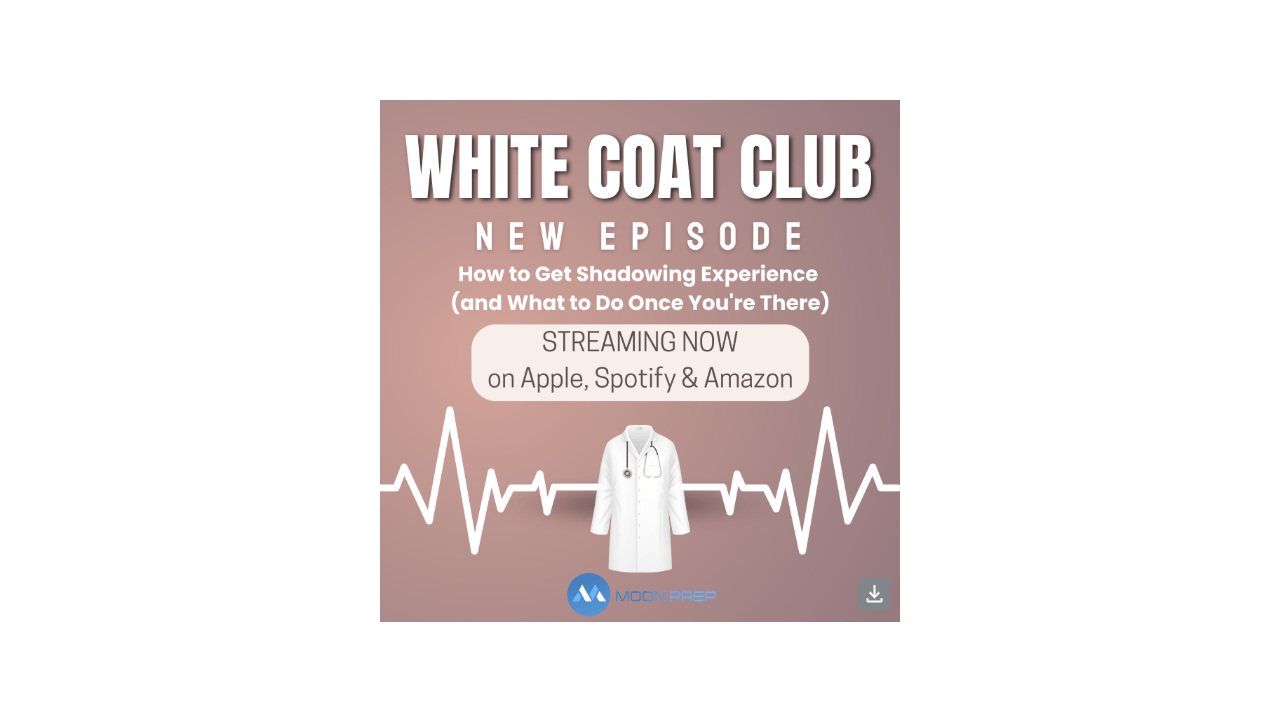
White Coat Club Episode: How to Get Shadowing Experience (and What to Do Once You’re There)
Shadowing is one of the most valuable experiences for students considering careers in healthcare—but many students aren’t sure where to start or how to make the most of the opportunity once they get it.
In this episode, Nicole and Muskan break down why shadowing matters, especially for students interested in BS/MD programs, pre-med pathways, and other healthcare careers. They discuss practical strategies for finding shadowing opportunities, including leveraging family connections, reaching out to physicians’ offices, exploring hospital volunteer programs, and using LinkedIn professionally.
They also share tips on what students should do before, during, and after a shadowing experience to leave a positive impression and gain meaningful insights into patient care, physician communication, and the realities of healthcare.
Whether you’re just beginning your healthcare journey or looking to strengthen your college applications, this episode will help you approach shadowing with confidence and purpose.
In this episode, you’ll learn:
- Why shadowing is important for aspiring healthcare professionals
- How shadowing can strengthen BS/MD and pre-med applications
- Creative ways to find shadowing opportunities
- Common mistakes students make when reaching out to physicians
- What to expect on your first day of shadowing
- How to maximize your learning and build professional relationships
Learn more or Listen here.
White Coat Club Episode: How to Get Research (and How to Succeed During)
Research is one of the most valuable experiences for students interested in medicine, BS/MD programs, and other healthcare careers—but finding opportunities can feel overwhelming, especially for high school students who don’t know where to start.
In this episode, Nicole and Muskan break down the different types of research available to students, how to find opportunities, and what it takes to become a valuable member of a research team. They discuss everything from summer research programs and independent projects to reaching out to professors and physicians for mentorship opportunities.
They also share practical advice on preparing for your first day in a lab or research setting, building professional relationships, taking initiative, and turning a research experience into meaningful growth.
Whether you’re hoping to strengthen your college applications, explore a future in medicine, or simply learn more about scientific discovery, this episode will help you navigate the world of research with confidence.
In this episode, you’ll learn:
- Why research is valuable for future healthcare professionals
- Different types of research experiences available to students
- Summer programs that offer research opportunities
- How to contact professors and potential mentors
- What to do before your first day in a lab or research setting
- How to stand out as a student researcher
- Ways to reflect on and maximize your experience
Learn more or Listen here.